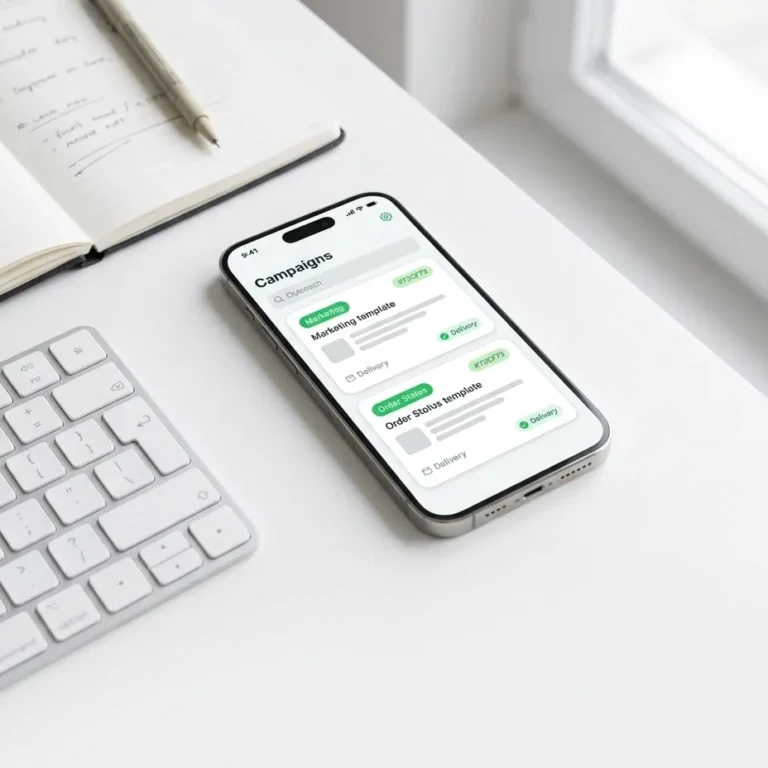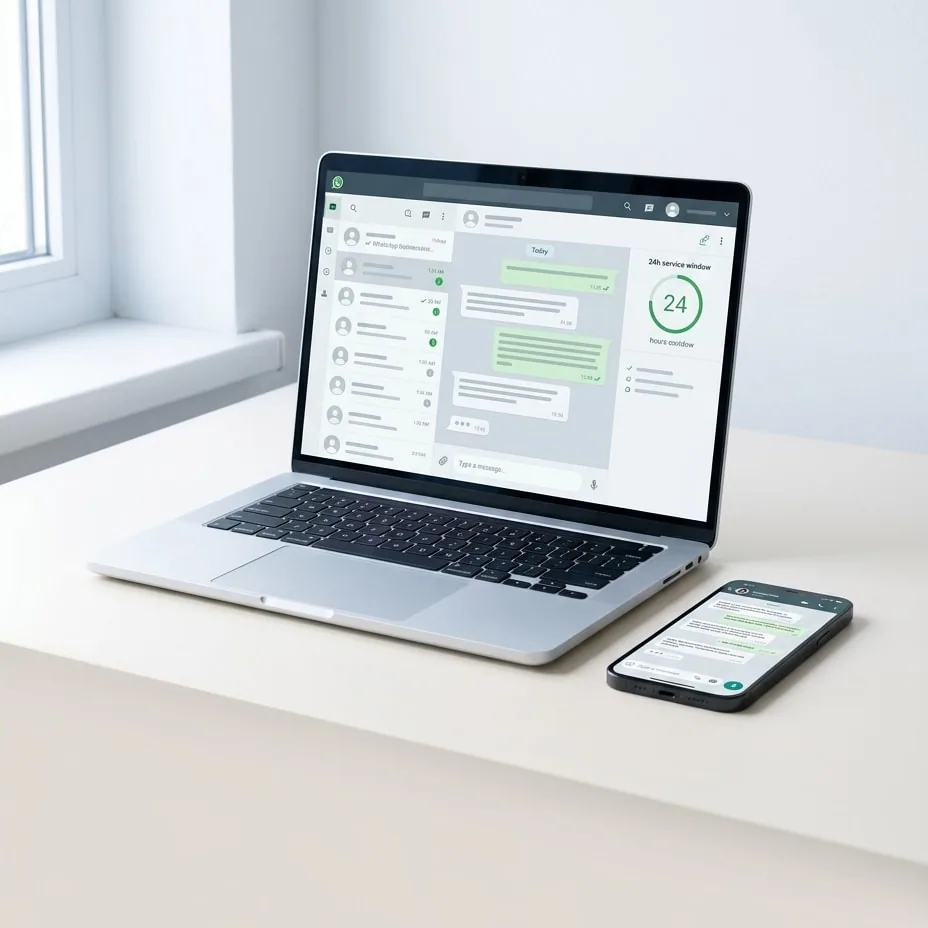
The WhatsApp API conversation pricing model operates on fixed 24-hour session windows rather than charging per individual message. When a customer initiates contact, a service conversation window opens the moment the business replies, allowing the business to exchange unlimited free-form messages with that user for 24 hours without pre-approved templates. Leveraging this 24-hour window alongside the 1,000 free monthly service conversations provided by Meta enables e-commerce brands and customer support teams to substantially reduce operational communication expenses.
A WhatsApp service conversation is defined as a user-initiated session in which a business responds within a standardized time frame. Understanding the technical distinction between customer-initiated interactions and business-initiated outbound broadcasts is the foundation of building a cost-effective messaging architecture.
Meta's Four Conversation Categories and Pricing Structure
Meta divides conversations within the WhatsApp Cloud API into four distinct categories. Each conversation category carries a separate regional rate determined by the country code of the recipient's phone number:
- Service Conversations: Inbound interactions initiated by a customer where the business replies using free-form messaging. These represent the lowest per-conversation rate across the platform.
- Utility Conversations: Business-initiated interactions delivering critical transactional data directly tied to an ongoing transaction, such as order confirmations, shipping tracking updates, or appointment reminders.
- Authentication Conversations: Specialized outbound interactions utilized to send one-time passcodes (OTP) for account verification and secure logins.
- Marketing Conversations: Outbound interactions initiated by the business to promote products, announce sales, re-engage abandoned shopping carts, or share product catalogs. This category carries the highest unit price.
To inspect exact country-specific rates across international territories, review the official Meta WhatsApp conversation pricing documentation.
| Conversation Category | Initiator | Approved Template Required | Relative Cost Index |
|---|---|---|---|
| Service Conversation | Customer | No (Free-form text/media) | Lowest (First 1,000 free/month) |
| Utility Conversation | Business | Yes (Pre-approved template) | Moderate |
| Authentication Conversation | Business | Yes (Pre-approved OTP layout) | Low to Moderate |
| Marketing Conversation | Business | Yes (Pre-approved template) | Highest |
A frequent architectural error made by engineering teams is dispatching a marketing template inside an open service window. Doing so instantly spawns a parallel marketing conversation session, resulting in a dual bill for the exact same contact. Careful template selection prevents misclassification and unnecessary platform fees.
The 24-Hour Service Window: Technical Mechanics Behind Free Sessions
A service conversation window is triggered at the infrastructure level when an incoming customer message is delivered via the system's messages Webhook event. Once received, the 24-hour timer starts. However, the financial charge for the service conversation is not incurred when the customer writes; it is billed only when the business transmits its first outbound reply.
Inside this active 24-hour window, every subsequent free-form message sent by the business costs nothing extra. If the customer sends another inbound message eight hours later, the 24-hour window resets completely from the timestamp of that latest user payload. Consequently, a complex technical support ticket can span several days under a single service conversation charge, provided the elapsed interval between incoming customer replies never exceeds 24 consecutive hours.
Furthermore, every official WhatsApp Business Account (WABA) receives a tier of 1,000 free service conversations during each calendar month. This free allocation applies strictly to customer-initiated service queries and excludes outbound marketing, utility, and authentication workflows.
Another significant operational benefit applies to Click-to-WhatsApp advertising campaigns across Facebook and Instagram. When a consumer contacts a business number by clicking an ad or a Facebook Page action button, Meta grants a free 72-hour messaging window. During this 72-hour window, all inbound and outbound messages remain entirely exempt from Meta conversation fees.
WhatsApp API Conversation Pricing: Service Messages vs. Marketing Templates
The financial variance between service messages and outbound promotional templates is substantial in digital commerce. When a customer reaches out to ask about product sizing or inventory availability, an immediate response qualifies as a service conversation. By utilizing this active interaction to answer the question, the business pays only the low service conversation tariff or absorbs it within the 1,000 free monthly tier.
Conversely, delivering a scheduled promotional notification to a user who has not messaged the business within the preceding 24 hours mandates a pre-approved Message Template and bills at the premium marketing rate. Firing an automated marketing template at a user who is actively chatting with support destroys the economic advantage of the open service window.
E-Commerce Conversation Management Architecture
To minimize communication expenditure in e-commerce deployments, such as stores running integrated enterprise storefronts, software engineers must establish an orchestration layer that logs interaction timestamps and dynamically routes traffic between unmetered free-form payloads and billable message templates.
A resilient technical routing pipeline operates through the following steps:
- Ingest Meta Webhook Payloads: Capture inbound message events, extracting the sender phone number and message timestamp.
- Persist User State in In-Memory Storage: Store the customer's phone number as an active session key in an in-memory cache such as Redis, configuring a Time-to-Live (TTL) of exactly 86,400 seconds (24 hours).
- Evaluate Window Status Prior to Dispatch: When a transactional event fires from your commerce platform (such as an abandoned checkout trigger or order dispatch notice), verify whether the recipient's phone number key exists in the cache.
- Execute Conditional Payload Routing:
– If the cache key exists: Transmit a standard, free-form text or media message without paying template charges, fully contained within the open service session. – If the cache key has expired or does not exist: Send an officially pre-approved message template following the guidelines in the Meta Cloud API guide on sending messages.
Tracking Conversation Windows with Webhooks and Redis
Maintaining strict synchronization with Meta's messaging platform requires lightweight backend logic listening to inbound message webhooks. Consider the incoming JSON payload structure:
{
  "object": "whatsapp_business_account",
  "entry": [{
    "id": "WABA_ID",
    "changes": [{
      "value": {
        "messaging_product": "whatsapp",
        "metadata": {
          "display_phone_number": "PHONE_NUMBER",
          "phone_number_id": "PHONE_NUMBER_ID"
        },
        "messages": [{
          "from": "15550199832",
          "id": "wamid.HBg...",
          "timestamp": "1710000000",
          "type": "text",
          "text": {
            "body": "Can you provide an update on my shipment?"
          }
        }]
      },
      "field": "messages"
    }]
  }]
}
Upon ingesting this webhook payload, the ingestion worker records the expiration deadline (timestamp + 86400) within Redis. Outbound customer service responses and conversational bot dialogues continue sending raw text payloads as long as that key remains active, without triggering secondary conversation billing cycles.
Common Architectural Pitfalls That Inflate Invoices
Development teams frequently encounter unexpected billing spikes due to architectural oversights:
- Breaching the 24-Hour Boundary: If a buyer submits an inquiry on Friday evening and an agent responds on Monday morning without an intermediary automated acknowledgment, the 24-hour service window has elapsed. Free-form messaging is rejected by the API, forcing the business to purchase an outbound template to re-engage.
- Transmitting Marketing Templates Inside Service Sessions: Automated broadcast workers that indiscriminately blast promotional templates will open an expensive marketing conversation even if an unmetered service conversation is currently open with that user. Promotional copy should be delivered as standard text within open windows.
- Failing to Deploy Immediate Bot Responders: Implementing an automated triage bot that acknowledges inbound questions immediately keeps the dialogue alive, prompts the user for clarification, and allows human support agents to reply during working hours without losing the customer-initiated window.
Mastering session routing and API categorization saves significant capital while providing responsive customer communication. If your engineering team is architecting an enterprise WhatsApp integration or auditing an existing messaging pipeline to eliminate redundant API billing, reach out to our technical team for an architectural review.
Common questions
How is a service conversation defined in the WhatsApp API?
A service conversation in the WhatsApp Business API is a user-initiated communication session. It triggers the moment an enterprise sends its first reply to an inbound customer message, opening an active 24-hour window. Inside this 24-hour timeframe, companies can send unlimited, free-form text and media messages without submitting pre-approved templates or incurring per-message fees, making it the most cost-efficient support channel.
How many free conversations does Meta provide each month?
Meta provides every official WhatsApp Business Account (WABA) with 1,000 free service conversations each calendar month. These free tiers reset at the beginning of each month based on the account's timezone. This monthly allowance applies exclusively to customer-initiated service conversations and does not cover business-initiated marketing, utility, or authentication conversations, which are billed according to standard regional category rates.
What happens when an agent replies to a customer after 24 hours?
When an agent responds after 24 hours have elapsed since the user's last message, the active service window is officially closed. The platform strictly prohibits sending standard free-form messages outside this window. To re-engage the customer, the business must send a paid, pre-approved message template, which opens a new 24-hour business-initiated conversation and incurs the corresponding category charge.
Is a conversation from a Facebook ad charged?
Conversations initiated through Facebook or Instagram Click-to-WhatsApp ads or Facebook Page call-to-action buttons qualify for a free 72-hour window. During this extended three-day period, Meta waives all conversation charges, allowing businesses to exchange unlimited customer service and promotional messages with the user without incurring standard conversation fees, significantly optimizing paid customer acquisition campaigns.
Try it on your own number.
WhatsApp, Messenger, Instagram and the AI chatbot — 7-day free trial, no credit card.